

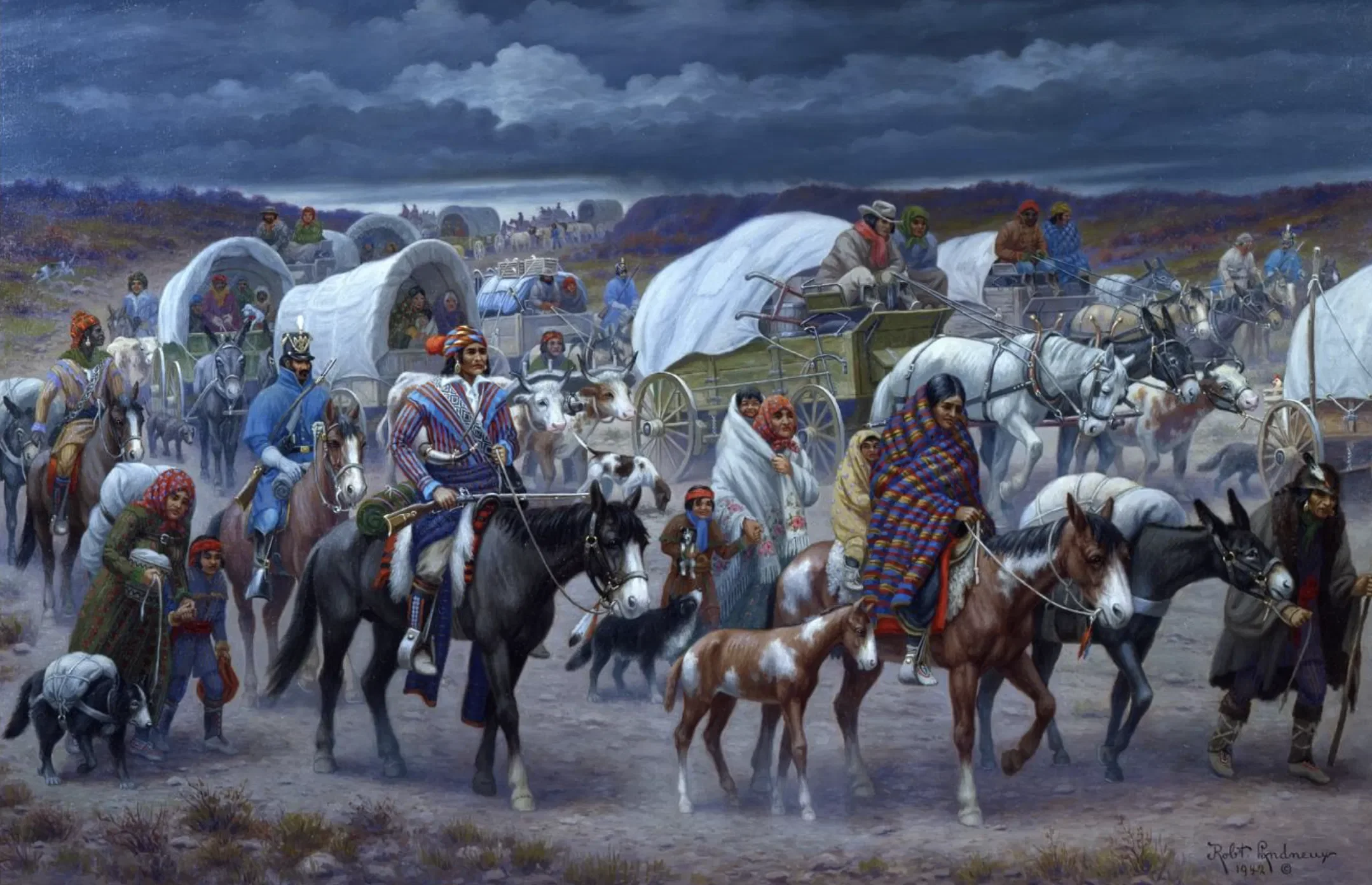
Trail of Tears
The Trail of Tears committee specializes on the issue of the removal and relocation of Native Americans under President Andrew Jackson’s administration, handling conflict between the US Government and indigenous groups, the balance of judicial and executive power, and the sovereignty of the Cherokee, Muscogee, Seminole, Chickasaw, and Choctaw.
Approximate committee size: 20 delegates
Committee Topics
-
1. Coexistence vs. Separation
From Jamestown in the colonial era through the early United States, relations between Native American tribes and European settlers have been shaped by conflict. As a result of Europeans vying for control over these tribes, tensions started in the 1600s. These fights continued for the next few centuries and into the creation of the United States. Several attempts at treaties were made, only to subsequently be broken by the US. Additionally, U.S. policy regarding Native Americans remains complex and unclear, leading to more confusion and political unrest. In pursuit of Manifest Destiny, many Americans are advocating for a massive displacement of Native Americans while others prefer methods of assimilation. Displacing natives would further sever ties between both the groups. On the other hand, historic examples of assimilation have proven to be suppressive. The ways in which delegates resolve this issue will impact the lives of both native tribes and Americans in future centuries. Therefore, it is pertinent that delegates find ways for both groups to coexist— or separate.
-
2. Enforcing and Responding to the Indian Removal Act
After the passage of the Indian Removal Act in 1830, President Andrew Jackson was granted the authority to drive Native American tribes out of their territories through the Trail of Tears. The act was controversial, with people having mixed opinions since it barely passed through the chambers of Congress. Furthermore, it is very vague in who is granted powers, for which reason states have begun to act independently. Minority parties in the government are also conflicted in their support of the act, and must double their efforts in order to oppose the reigning party. On the flip side, proponents of the act must minimize opposition. Amongst native tribes, there have also been different reactions with many tribes being amenable to the act while other tribes are resisting removal. This committee must address the problems and concerns surrounding this act at the risk of threatening future U.S. relations with Indigenous people.
Committee Chairs
-

Aditi Kumar
Aditi Kumar is a sophomore at Maggie Walker that cannot wait to be a co-chair for the GSMUN XXVIII Trail of Tears committee! Over the past four years, she has competed in over a dozen conferences, winning several awards. Last year, she also had the honor to serve as a vice-chair for GSMUN. Aside from Model UN, Aditi plays the flute and piano, dances, and is a director for the school newspaper. She is very interested in the politics and history of the United States. Aditi is super excited to meet all the delegates and work with them to run a successful Trail of Tears committee!
-

Tayyib Ali
Tayyib Ali, a junior at Maggie Walker, is incredibly excited to serve as one of your co-chairs for the Trail of Tears! This is his third year being involved in Model UN and GSMUN at Maggie Walker. Outside of Model UN, Tayyib participates in Quiz Bowl, plays trumpet, and enjoys playing tennis. He also loves traveling and learning about new cultures. He can’t wait to meet all of the delegates and hear everyone’s ideas in committee!